
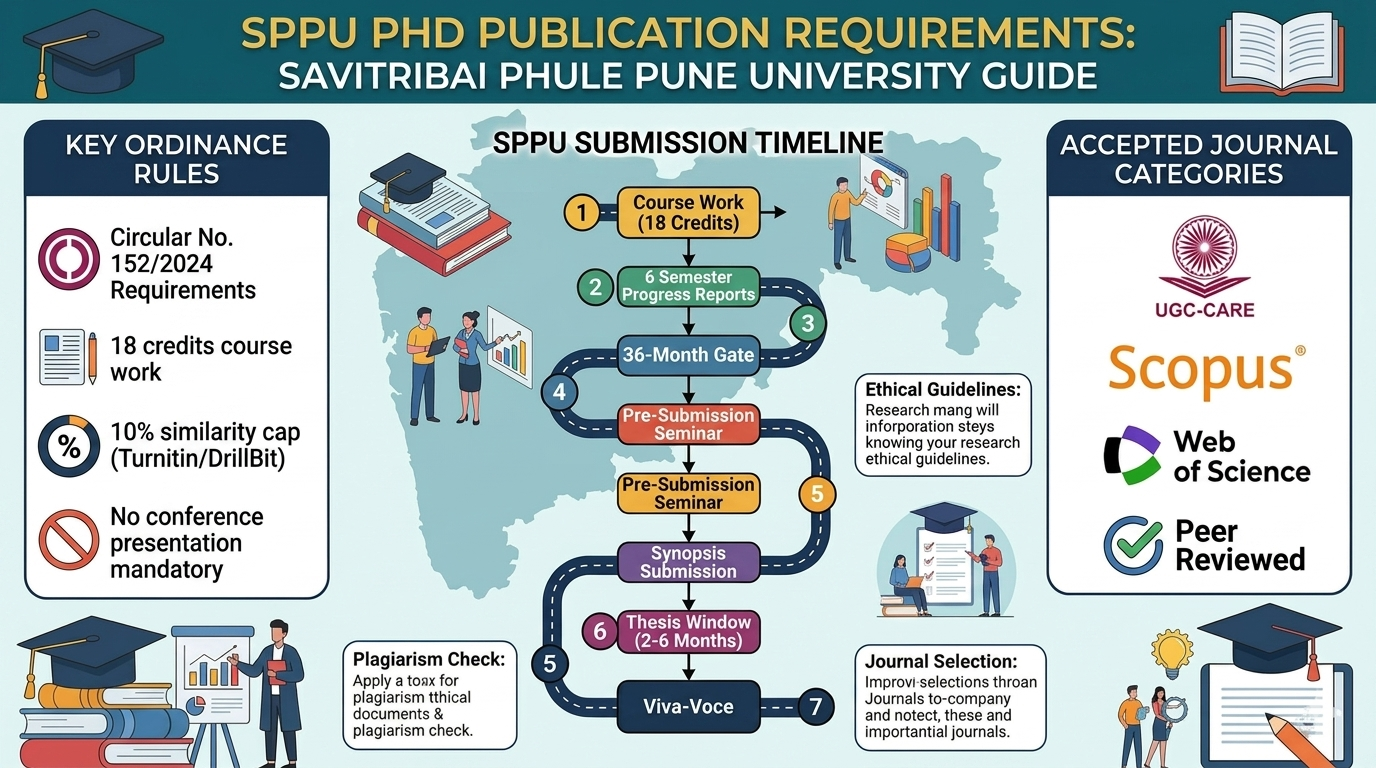
Savitribai Phule Pune University (SPPU), established in 1949 and one of the largest research universities in Maharashtra, revised its Ph.D. Ordinance in July 2024 to align with the UGC 2022 doctoral regulations. The revision changed what SPPU scholars must produce before thesis submission — most notably, research paper presentation is no longer required, and the ordinance no longer states a fixed number of publications. This page sets out what the current SPPU rules actually say, where the publication requirement now comes from, and the full submission sequence from course work to viva.
📍 Part of our Maharashtra university requirements guide. See also: Paper Publication in Maharashtra · For PhD Scholars · UGC-CARE · Scopus
SPPU PhD Publication Requirement — What the Ordinance Says
| Governing ordinance | Circular No. 152/2024, dated 09 July 2024 — approved by the Academic Council on 22 June 2024, framed under the UGC (Minimum Standards and Procedures for Award of Ph.D. Degrees) Regulations, 2022 |
| Papers required | No fixed number stated in the ordinance. It defers to publication guidelines issued by SPPU from time to time and displayed on the university website |
| Journal categories accepted | Web of Science / Scopus / Peer Reviewed / UGC approved |
| Conference presentations | Not required — research paper presentation has been dropped |
| Seminars | Attendance at a minimum of two national or international seminars, as part of course work |
| Course work | 18 credits, minimum 55% or equivalent grade, cleared within the first two years |
| Plagiarism ceiling | 10% or less; plagiarism certificate compulsory |
| Plagiarism software | DrillBit, Turnitin |
| Pre-submission seminar | Mandatory, at least three months before thesis submission |
| Minimum before synopsis | 36 months from registration, course work complete |
| Programme duration | Minimum 3 years, maximum 6 years; up to 8 years with re-registration |
Sourced from the official SPPU Ph.D. admission FAQ and the Ph.D. Regulations circular published by the PG Admission Section. Last verified 17 August 2026. SPPU Ph.D. FAQ · SPPU Ph.D. Rules & Regulations (PDF). Ordinances and circulars are amended without public notice — confirm with the PG Admission Section before you rely on this.
What Actually Changed in the 2024 Ordinance
If a senior scholar or a coaching website told you that SPPU requires one refereed journal paper plus two conference presentations, that was the position under the 2016-based regulations. It is no longer current. Under the July 2024 ordinance:
- Paper presentation at conferences is not required. The requirement to make two presentations before submission has been removed. Attending two seminars remains, but as a course work component.
- The number of publications moved out of the ordinance. Rather than fixing a count, SPPU now points to publication guidelines it issues from time to time. This means the binding number can change without the ordinance changing — and that your research centre, not a website, is the authority on it.
- The accepted journal categories are named. Web of Science, Scopus, peer reviewed and UGC approved. This is broader than a UGC-CARE-only requirement, which matters when you are shortlisting.
Ask your research centre for the publication guideline currently in force, in writing, and keep a dated copy. A guideline you confirmed at registration may not be the one applied at submission.
Which Journals to Target as an SPPU Scholar
All four accepted categories are open to you. The choice is really about timeline versus what you want the publication to do after your viva:
| Route | Realistic timeline | Indicative cost (INR) | Best for |
|---|---|---|---|
| UGC-CARE | 3–6 weeks | From 3,000 | Fastest route to submission compliance |
| Scopus | 4–12 weeks | From 15,000 | Named in the SPPU categories; stronger CV signal |
| SCI / Web of Science | 3–6 months | From 25,000 | Faculty promotion, API/CAS scoring |
| IEEE | 2–5 months | From 18,000 | Engineering & computing departments |
| Springer | 2–5 months | From 18,000 | Multidisciplinary work |
| Fast track | 7 days – 4 weeks | From 5,000 | Synopsis already submitted, clock running |
Full breakdown on our paper publication cost page.
The SPPU Submission Sequence
SPPU's timeline is unusually prescriptive, and the windows are what catch people out. In order:
- Course work — 18 credits cleared at 55% or above, within two years of admission.
- Progress reports — a minimum of six, presented to your Research Advisory Committee each semester and forwarded by the Head of the Place of Research within a week.
- 36-month gate — the synopsis may not be submitted before 36 months from registration, and not before course work is complete.
- Pre-submission seminar — held at least three months before thesis submission, arranged by the Head of the Place of Research.
- Synopsis — submitted to the PG Admission Section through your research supervisor within thirty days of the pre-submission presentation.
- Thesis window — after two months and within six months of synopsis submission. Past six months, ₹1,000 per month applies up to one year; past one year the synopsis must be presented again.
- Evaluation — supervisor plus at least two external examiners outside SPPU jurisdiction, with one from outside India where possible.
- Viva-voce — supervisor, at least one external examiner and a chairperson; held online or offline, open to the RAC, faculty and other researchers.
The trap: that two-to-six month thesis window is narrow, and it starts the moment your synopsis is in. A paper still under review when the synopsis is submitted has roughly six months to reach publication before the fine starts. Publish before the synopsis, not after.
SPPU Thesis Submission Checklist
- 18 course work credits cleared at 55% or above — Research Methodology, two seminars, two subject-specific advanced courses, Research & Publication Ethics, pedagogical training or industrial visit report
- Six semester-wise progress reports signed by the RAC
- Publication evidence per the SPPU research publication guideline currently in force — reprints or acceptance letters from the publisher or editor
- Plagiarism certificate showing 10% similarity or less, via DrillBit or Turnitin
- Pre-submission seminar completed at least three months prior
- Synopsis lodged with the PG Admission Section within thirty days of that seminar
- Registration still valid on the date of thesis submission
- Abstract copies in the prescribed format alongside the thesis
Forms, current circulars and the fee structure: SPPU PG Admission Section — pgadmis@pun.unipune.ac.in, 020-25621205.
Plan Backwards From Your Synopsis Date
Because SPPU ties the thesis window to the synopsis, work backwards from the synopsis, not the thesis:
- T−12 months — confirm the current SPPU publication guideline with your research centre in writing; carve publishable units out of your chapters; shortlist journals within the four accepted categories.
- T−10 months — first submission. Assume it comes back; roughly half of first submissions are rejected or returned with major revisions.
- T−7 months — revise and resubmit, or reroute to the next journal without losing a review cycle.
- T−5 months — acceptance and DOI. This should land before your pre-submission seminar.
- T−3 months — pre-submission seminar, plagiarism certificate, RAC clearances.
- T−0 — synopsis submitted; thesis follows in the two-to-six month window.
Frequently Asked Questions — SPPU PhD Publication
How many papers are required for a PhD at SPPU?
SPPU's current Ph.D. Ordinance does not fix a number. It states that guidelines for research publications issued by the university from time to time, and displayed on the official SPPU website, will be followed — naming Web of Science, Scopus, peer-reviewed and UGC-approved journals as the accepted categories. In practice most research centres continue to expect at least one journal publication before the pre-submission seminar. Because the number comes from a separately issued circular rather than the ordinance itself, ask your research centre for the publication guideline currently in force and keep a copy.
Does SPPU still require two conference presentations?
No. The SPPU Ph.D. admission FAQ states that research paper presentation is not required. This is a change from the 2016-based regulations, under which scholars had to make two paper presentations at conferences or seminars before thesis submission. You do still have to attend at least two national or international seminars, but that sits inside the course work, not the submission requirement.
What is the plagiarism limit for an SPPU thesis?
Similarity must be 10 percent or less, and submitting the plagiarism certificate is compulsory. SPPU names DrillBit and Turnitin as the software used. Each research centre also maintains a Departmental Academic Integrity Panel. Run your own similarity check before the official one — the centre's report is the binding version and there is rarely time to rewrite chapters after it.
How many credits is SPPU PhD course work?
Eighteen credits, made up of Research Methodology, attendance at a minimum of two national or international seminars, at least two subject-specific advanced courses, Research and Publication Ethics, and pedagogical training or an industrial visit report. Course work must be cleared with at least 55 percent, or the equivalent grade on the UGC ten-point scale, within the first two years.
When can I submit my SPPU synopsis and thesis?
The synopsis may be submitted only after 36 months from registration and after the course work is complete. A pre-submission seminar must be held at least three months before thesis submission, and the synopsis reaches the PG Admission Section within thirty days of that presentation. The thesis is then submitted after two months and within six months of synopsis submission. Beyond six months a fine of ₹1,000 per month applies up to one year, after which the synopsis must be presented again.
How long do I have to complete a PhD at SPPU?
Minimum three years including course work, maximum six years from the date of admission. Re-registration can add up to two more years, capped at eight years overall. Female scholars and persons with more than 40 percent disability get an additional two-year relaxation, with a ten-year outer limit.
Which journals should SPPU scholars target?
The ordinance's accepted categories are Web of Science, Scopus, peer-reviewed and UGC-approved journals. For submission compliance a UGC-CARE listed journal is the fastest route. Scopus or SCI publications carry more weight later, in API and CAS promotion scoring and in post-doctoral applications, so plan the target level around what you want the paper to do after your viva, not only around clearing submission.
Not Sure Your Paper Is Ready?
Send your draft for a free readiness check. You will get an honest assessment of whether it is publishable as it stands, which journals fit your subject and the SPPU accepted categories, and a realistic timeline measured against your synopsis date.
📄 Free Manuscript Evaluation — SPPU Scholars