
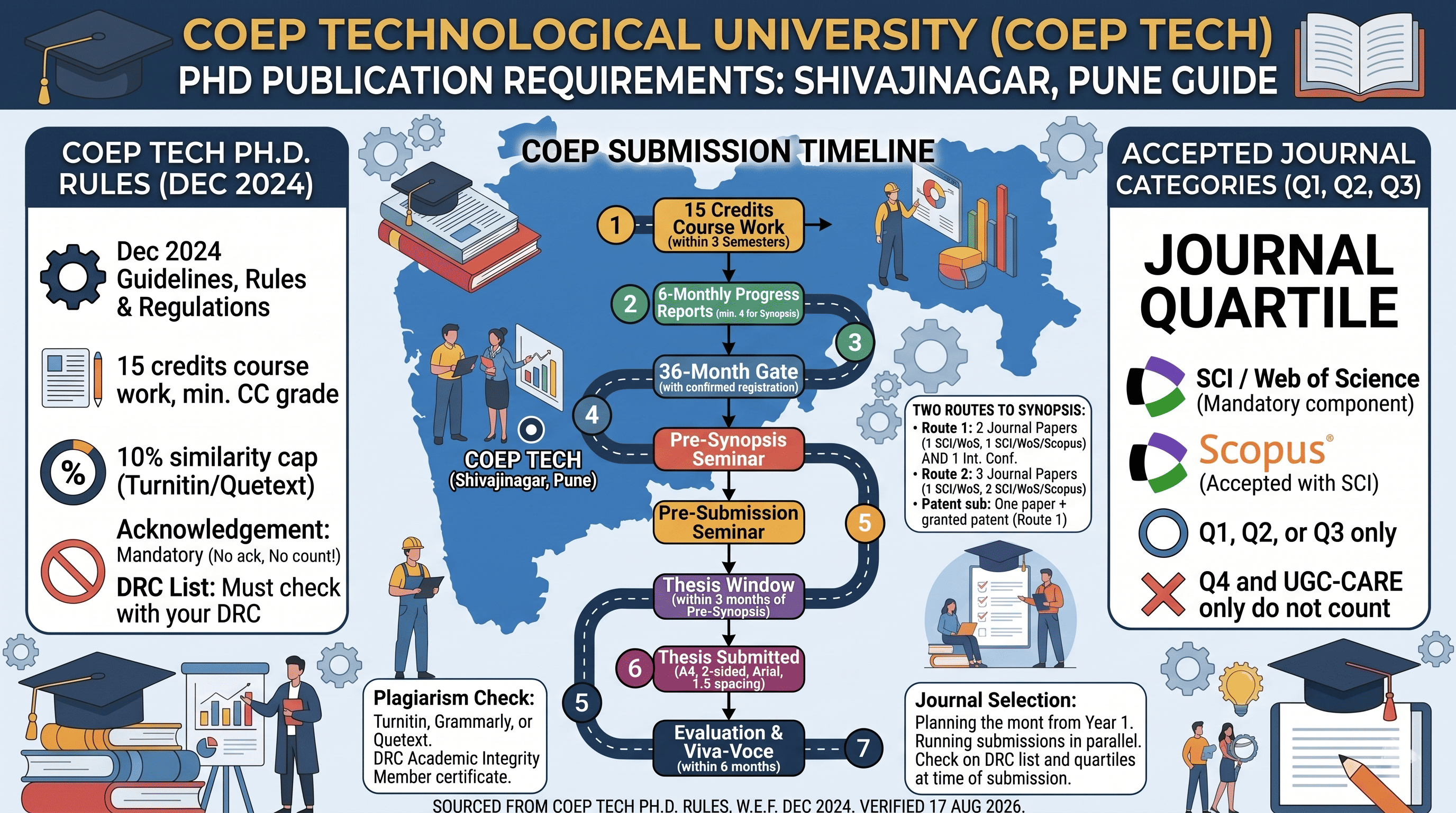
COEP Technological University (COEP Tech) is a unitary public university of the Government of Maharashtra at Shivajinagar, Pune. The institution dates to 1854 as the College of Engineering Pune — the third oldest engineering institute in the country — and was conferred unitary state university status on 21 June 2022. Its Ph.D. Rules were revised with effect from December 2024, and they carry the strictest publication requirement of any university in Maharashtra: two or three journal papers in Q1, Q2 or Q3 journals indexed in SCI, Web of Science or Scopus. A UGC-CARE listing does not satisfy it. This page sets out exactly what the rules require and the full sequence from course work to defence.
📍 Part of our Maharashtra university requirements guide. See also: Paper Publication in Maharashtra · SPPU · Scopus · SCI
COEP Tech PhD Publication Requirement — What the Rules Say
| Governing rules | Guidelines, Rules and Regulations Governing Ph.D. Programs, w.e.f. December 2024 (Academic Council, 30 November 2024) |
| Papers required | Option 1: two Q1/Q2/Q3 journal papers (one SCI/WoS, one SCI/WoS/Scopus) OR one SCI/WoS/Scopus paper plus one granted India/US patent — AND one international conference of high repute. Option 2: three Q1/Q2/Q3 journal papers (one SCI/WoS, two SCI/WoS/Scopus) |
| Journal quartile | Q1, Q2 or Q3 only — Q4 does not count |
| Indexes accepted | SCI / Web of Science / Scopus. UGC-CARE alone is not sufficient |
| Published or accepted | Either — acceptance for publication is enough |
| Acknowledgement clause | Papers must acknowledge COEP Tech University and the Centre of Excellence, or they are not counted |
| Course work | Minimum 15 credits, minimum grade CC, within 3 semesters of provisional admission |
| Registration seminar | Within 18 months of admission |
| Plagiarism ceiling | 10% — Turnitin, Grammarly or Quetext; certificate from DRC Academic Integrity Member |
| Synopsis gate | Confirmed registration + minimum 3 years after admission confirmation + at least 4 progress reports |
| Pre-synopsis seminar | At least 3 months before thesis submission |
| Thesis window | Within 3 months of the pre-synopsis seminar; fine thereafter, up to 1 year maximum |
| Programme duration | Minimum 3 years (4 for B.E./B.Tech. direct entrants), maximum 6; extension up to 2 more |
| Part-time / distance | Part-time not currently allowed; distance mode not allowed in any case |
Sourced from the COEP Tech Ph.D. Rules and Regulations, w.e.f. December 2024. Last verified 17 August 2026. Ph.D. Rules (PDF) · COEP Tech PhD admission. Rules are amended by the Academic Council without public notice — confirm with your DRC before relying on this.
The Two Routes to a COEP Tech Synopsis
Your synopsis is accepted only when one of these is complete. Choose early, because they diverge by roughly a year of planning:
| Option 1 | Option 2 | |
|---|---|---|
| Journal papers | Two Q1/Q2/Q3 — at least one SCI/WoS indexed, the other SCI/WoS/Scopus | Three Q1/Q2/Q3 — at least one SCI/WoS indexed, the other two SCI/WoS/Scopus |
| Patent substitution | One Q1/Q2/Q3 SCI/WoS/Scopus paper plus one granted India or US patent | Not applicable |
| Conference | One international conference of high repute, held periodically with enough iterations | Not required |
Beyond the count, three conditions decide whether a paper actually counts:
- Quartile. Q4 journals do not qualify under either option, even when indexed in Scopus. Check the current quartile in the year you submit, not the year you drafted.
- Acknowledgement. Every publication must acknowledge COEP Tech University and the Centre of Excellence where the work was done. Papers that omit it are excluded — this is the single most avoidable way to lose an otherwise compliant publication.
- The DRC list. Each DRC maintains and periodically revises its own list of refereed international journals, and the RRC issues publication guidelines separately. Ask your DRC for the current list before you choose a target journal.
The DC can also approve non-conventional research outcomes in place of conventional output — transferable prototyped technology, a commercialisable novel product or service, a patented innovation that has cleared IPR scrutiny, or an academic product with national or global recognition. If your work is closer to engineering practice than to journal output, raise this with your DC early rather than forcing a paper.
Why COEP Tech Differs From SPPU
Many COEP Tech supervisors hold SPPU recognition, and the two institutions were linked for decades — so SPPU-era advice circulates freely on campus. It does not apply. SPPU fixes no number in its ordinance and accepts Web of Science, Scopus, peer-reviewed and UGC-approved journals. COEP Tech fixes a number, restricts it to Q1–Q3, excludes UGC-CARE-only journals, and adds a conference and an acknowledgement clause. If someone tells you one CARE paper will do, they are describing a different university.
The UGC (Minimum Standards and Procedure for Award of Ph.D. Degree) Regulations, 2022 removed the national publication mandate and left the standard to each institution. COEP Tech used that freedom to raise the bar, not lower it.
Which Journals to Target
The binding constraint is Q1–Q3 in SCI, Web of Science or Scopus. Realistic routes and timelines:
| Route | Realistic timeline | Indicative cost (INR) | Best for |
|---|---|---|---|
| SCI / Web of Science | 3–6 months | From 25,000 | Q1–Q3 requirements |
| Scopus | 4–12 weeks | From 15,000 | Indexed-journal clauses |
| IEEE | 2–5 months | From 18,000 | Engineering & computing |
| Springer | 2–5 months | From 18,000 | Multidisciplinary work |
| UGC-CARE | 3–6 weeks | From 3,000 | Peer-reviewed clauses |
| Fast track | 7 days – 4 weeks | From 5,000 | Deadline already close |
Full breakdown on our paper publication cost page.
COEP Tech Thesis Submission Checklist
- 15 course work credits at minimum grade CC, completed within three semesters
- PhD registration seminar presented and approved within 18 months of admission
- Progress seminars before your DC every six months, in December and July — three consecutive missed reports cancel your registration
- At least four completed progress reports before the synopsis
- Publications complete under Option 1 or Option 2, with the COEP Tech acknowledgement
- Pre-synopsis seminar before the DC, external expert and an RRC member, at least three months before thesis submission
- Seven hard copies and a soft copy of the synopsis, with a panel of six domain experts
- Plagiarism report at 10% or below, with the DRC Academic Integrity Member's certificate
- Four soft-bound thesis copies plus digital copy to the Board of Examinations and Evaluation — A4, both sides, 1.5 spacing, Arial, 1.5 inch left margin
- Supervisor's certificate and candidate's declaration bound in
The title is fixed at the pre-synopsis seminar and cannot be changed afterwards. Thesis evaluation goes to three external examiners drawn from centrally funded institutes, institutes of national importance, universities inside the top 100 NIRF bracket, or institutions within the QS top 500, and the whole evaluation must conclude within six months of submission.
Plan Backwards From Your Synopsis
COEP Tech's requirement is heavy enough that publication planning has to start with your research plan, not after it:
- Year 1 — clear course work inside three semesters and present the registration seminar. Ask your DRC for its approved journal list now, while you still have freedom in framing the work.
- Year 2 — first journal submission. SCI and Web of Science review cycles run three to six months, and a rejection costs you a full cycle, so the first attempt needs to be in the water by the end of year two.
- Year 2–3 — conference paper if you are taking Option 1, and the second journal submission running in parallel rather than sequentially.
- Year 3 — acceptances in hand. The three-year synopsis gate means there is no benefit in being ready earlier, but a large penalty in being ready later.
- Synopsis −3 months — pre-synopsis seminar, plagiarism certificate, examiner panel.
- Synopsis +3 months — thesis submitted, or the fine starts.
Scholars who leave publication to the third year are the ones who end up submitting the pre-synopsis twice. Running two journal submissions concurrently from year two is the single most effective thing you can do here.
Frequently Asked Questions — COEP Tech PhD Publication
How many papers are required for a PhD at COEP Tech?
Two or three, depending on which route you take. Under the December 2024 Ph.D. Rules, the synopsis is accepted only if you have either two Q1/Q2/Q3 journal publications (at least one SCI or Web of Science indexed, the other SCI/WoS/Scopus) plus one international conference of high repute, or three Q1/Q2/Q3 journal publications on the same indexing split. A single SCI/WoS/Scopus paper plus one granted Indian or US patent can substitute for the two-journal option, still with the conference. Papers may be published or accepted for publication.
Does COEP Tech accept UGC-CARE journals?
No. The rules specify Q1, Q2 or Q3 journals indexed in SCI, Web of Science or Scopus. A UGC-CARE listing on its own does not satisfy the synopsis condition, and neither does a Q4 journal in an accepted index. COEP Tech is among the strictest publication requirements of any university in Maharashtra — plan for indexed-journal review cycles from the start rather than assuming a CARE journal will clear the gate.
Do I have to acknowledge COEP Tech in my paper?
Yes, and this one catches people out. All publications arising from research at the university must acknowledge COEP Tech University and the Centre of Excellence where the work was carried out. Publications that omit the acknowledgement are not considered for thesis submission — so a paper that is otherwise perfectly compliant can be rejected on this alone. Check the acknowledgement wording before you submit to the journal, not after acceptance.
What is the plagiarism limit for a COEP Tech thesis?
A maximum of 10 percent similarity, certified by authenticated plagiarism software such as Turnitin, Grammarly or Quetext. The certificate must come from the Academic Integrity Member of your DRC and is submitted with the thesis. A thesis found to be copied is forfeited and the registration terminated, and the supervisor's recognition is withdrawn for two years.
How much course work does COEP Tech require?
A minimum of 15 credits: Research Methodology (2), Research and Publication Ethics (2), Writing Research Proposal and Literature Review (2), and at least three domain-specific courses (9). You need a minimum grade of CC in each on the 10-point scale, and the whole course work must be completed within three semesters of provisional admission or the admission is cancelled. Candidates admitted directly on a B.E. or B.Tech. basis take an additional 12 credits in one extra semester.
When can I submit my COEP Tech synopsis and thesis?
The synopsis requires confirmed registration, a minimum of three years after admission confirmation, and at least four successfully completed progress reports. A pre-synopsis seminar is held at least three months before thesis submission. The thesis is then due within three months of that seminar; later submission attracts a fine and is permitted up to one year, after which you must present the pre-synopsis again.
Can I do a part-time PhD at COEP Tech?
Not as a conventional part-time programme, and distance mode is not permitted in any case. There is a separate PhD for Working Professionals route with its own provisions: no GATE, NET, CAT or GMAT requirement, an industry co-supervisor, the option to use your workplace as an extended place of research, and a minimum duration of 48 months against a maximum of 84. The synopsis publication conditions apply to that route unchanged.
Choosing the Right Target Journal
Because COEP Tech restricts you to Q1–Q3 indexed journals, the expensive mistake here is not cost — it is aiming at a journal that will reject you after four months, or one that turns out to sit in Q4 when you check at submission. Send us your draft and target list for a free readiness check: an honest assessment of whether the manuscript is competitive at the quartile you need, where the scope fit is strongest, and how the review timeline maps onto your three-year synopsis gate.
📄 Free Manuscript Evaluation — COEP Tech Scholars