
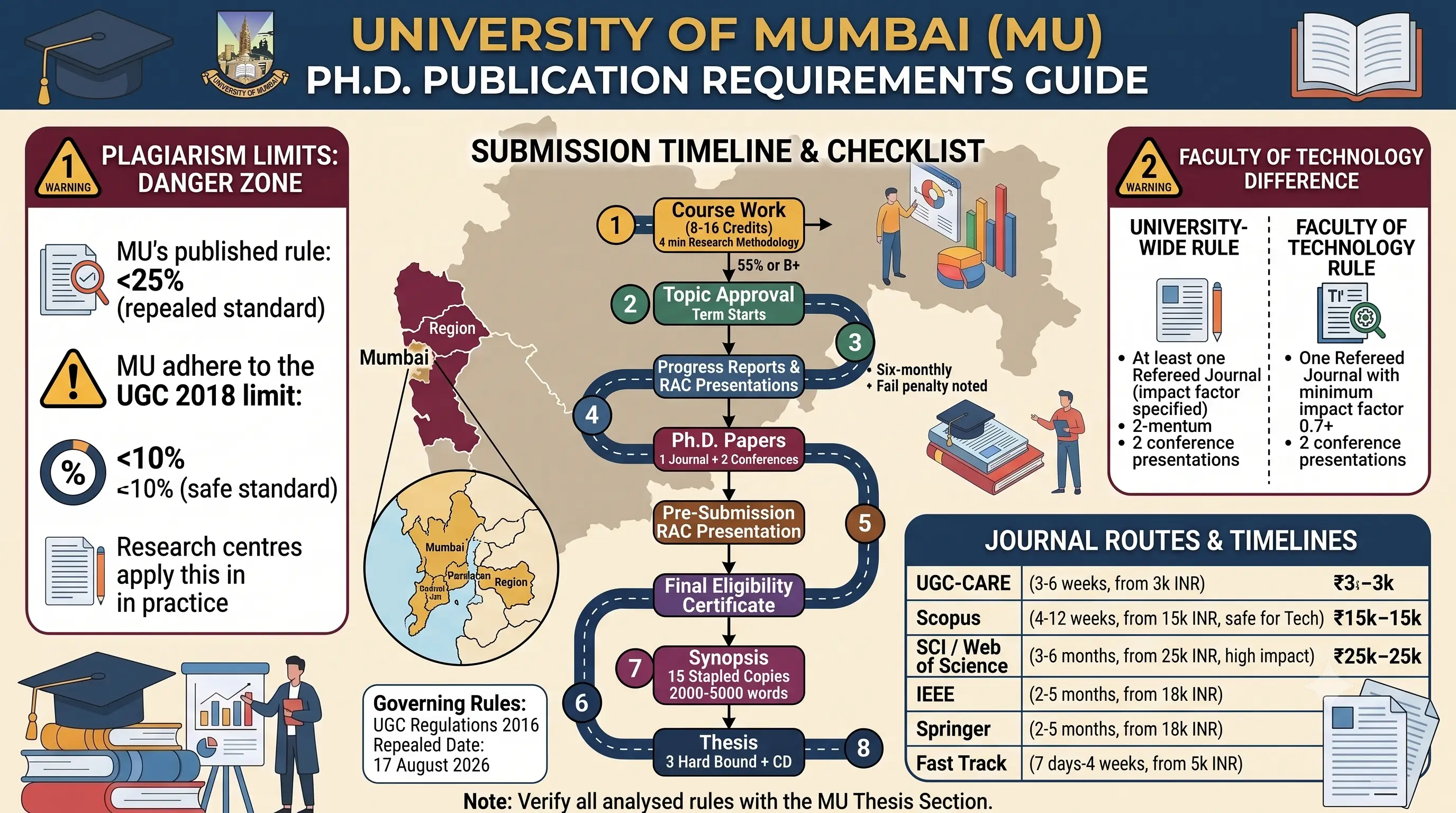
The University of Mumbai (MU), founded in 1857, is one of India's largest universities, with research centres spread across hundreds of affiliated colleges and recognised institutions. Its Ph.D. rules require at least one research paper in a refereed journal and two paper presentations at conferences or seminars before the thesis is submitted for adjudication. Two things make MU harder to navigate than most: the Faculty of Technology adds an impact factor condition that the University-wide rule does not, and the published plagiarism figure is dangerously out of step with current UGC standards. This page sets out both, plus the full submission sequence.
📍 Part of our Maharashtra university requirements guide. See also: Paper Publication in Maharashtra · SPPU · UGC-CARE · Scopus
Mumbai University PhD Publication Requirement — What the Rules Say
| Governing rules | Rules to consider the Proposals for Award of M.Phil./Ph.D. Degree, framed in consonance with the UGC Regulations 2016; repealed Ordinances 5473–5482 and VCD/2414 of 2010 |
| Papers required | At least one research paper in a refereed journal (Rule 17.4) |
| Conference presentations | Two, at conferences or seminars |
| Indexing condition | None University-wide. Faculty of Technology requires minimum impact factor 0.7 and above |
| Evidence required | Presentation certificates and/or reprints, before submission for adjudication |
| Course work | Minimum 8 and maximum 16 credits, at least 4 on Research Methodology; 55% or B+ required; first year |
| Plagiarism ceiling | Published rules say above 25% is not acceptable — but UGC 2018 sets 10%; see the warning below |
| Pre-submission presentation | Before the Research Advisory Committee, open to all faculty and researchers |
| Progress monitoring | Six-monthly reports and presentations; three consecutive failures can cancel registration |
| Synopsis | 15 stapled copies, 2,000–5,000 words, 10–25 pages including cover, in English |
| Thesis | Three hard bound copies plus compact disk; final hard bound copy and CD after viva |
| Examiners | Guide plus at least two examiners nominated by the Vice Chancellor, one from outside the State |
| Programme duration | Minimum 3 consecutive years including course work, maximum 6; term runs from RRC topic approval |
| Part-time / distance | Part-time permitted; distance mode not permitted |
Sourced from the University of Mumbai's Rules to consider the Proposals for Award of M.Phil./Ph.D. Degree, and from the Faculty of Technology Ph.D. rules. Last verified 17 August 2026. Confirm with the MU Thesis Section and your research centre before relying on this — see the two warnings below.
Warning 1: The 25% Plagiarism Figure Is Not Safe to Use
MU's published rules state that duplication or plagiarism above 25 percent is not acceptable. Do not plan around that number.
The UGC (Promotion of Academic Integrity and Prevention of Plagiarism in Higher Educational Institutions) Regulations, 2018 set the standard at 10 percent similarity for no penalty, with a penalty ladder above that, and they apply to every higher education institution in the country. MU's 25 percent figure sits in a document framed under the UGC's 2016 doctoral regulations and predates that integrity framework. Research centres apply the 10 percent standard in practice.
A scholar who reads MU's rules literally, submits at 20 percent similarity and is then assessed against the 10 percent standard has a serious problem discovered very late. Target 10 percent, run your own similarity check before the official one, and confirm the threshold with your research centre in writing.
Warning 2: Technology Scholars Have a Different Rule
The University-wide rule asks only for a refereed journal. The Faculty of Technology asks for a refereed journal with a minimum impact factor of 0.7 and above. That single clause changes your entire journal shortlist, because a large number of journals that satisfy the general MU rule carry no impact factor at all.
| University-wide rule | Faculty of Technology | |
|---|---|---|
| Journal papers | At least one, refereed | One, refereed |
| Impact factor | Not specified | Minimum 0.7 and above |
| Presentations | Two, conferences or seminars | Per faculty rules — confirm with your centre |
| Examiners | Two, one from outside the State | Two, with one drawn from the IITs |
MU is large and decentralised, and faculties have historically issued their own supplementary Ph.D. rules. Engineering, Management, Law and Science scholars should each ask their research centre for the faculty-level rules in force, in writing, rather than assuming the University-wide document is the whole picture. This is the single most common way MU scholars get caught out.
Are These Rules Still Current?
MU's Ph.D. rules are framed in consonance with the UGC (Minimum Standards and Procedure for Award of M.Phil./Ph.D. Degree) Regulations, 2016. The University's own Standard Operating Procedure for Ph.D., published in 2022, also references the 2016 regulations. We could not find a revised Ph.D. ordinance reflecting the UGC Regulations 2022 published on MU's public pages.
That matters because the 2022 regulations removed the national requirement to publish and present before submission. Universities were left free to keep their own rules, and many did — DPU retained both, while SPPU dropped the presentation requirement. Until MU publishes a revision, its 2016-based rules govern you.
Ask the Thesis Section directly whether a post-2022 Ph.D. ordinance or circular exists, and get the answer in writing. Do not rely on a senior scholar's recollection, and do not rely on a page like this one alone — including this one.
Which Journals to Target
For most faculties the constraint is genuine peer review. For Technology it is an impact factor of 0.7 or above. Realistic routes:
| Route | Realistic timeline | Indicative cost (INR) | Best for |
|---|---|---|---|
| UGC-CARE | 3–6 weeks | From 3,000 | Arts, Commerce, Law, Science — refereed, fast |
| Scopus | 4–12 weeks | From 15,000 | Carries an impact factor; safe for Technology |
| SCI / Web of Science | 3–6 months | From 25,000 | Comfortably clears the 0.7 threshold; API/CAS scoring |
| IEEE | 2–5 months | From 18,000 | Faculty of Technology scholars |
| Springer | 2–5 months | From 18,000 | Multidisciplinary and applied work |
| Fast track | 7 days – 4 weeks | From 5,000 | Presentation done, paper outstanding |
Full breakdown on our paper publication cost page. If you are in Technology, verify the journal's current impact factor at the time you submit — it changes annually and a journal that cleared 0.7 last year may not this year.
The Mumbai University Sequence
- PET — Part A is a common one-hour 50-mark MCQ paper on intelligence, general knowledge, reasoning, comprehension, language and research methodology; Part B is a two-hour 50-mark subject paper; Part C is a presentation or interview at your research centre. You must qualify in both written parts at 50 percent aggregate. Holders of NET, SET, SLET, JRF, GATE, GPAT, INSPIRE and M.Phil. are exempt.
- Admission — research centres advertise vacancies per guide; the RAC assigns guides. A Professor may hold 8 Ph.D. candidates, an Associate Professor 6, an Assistant Professor 4.
- Topic approval — the RRC approves, rejects or modifies your title. Your term starts from the date of topic approval, not from admission.
- Course work — 8 to 16 credits in the first year, at 55 percent or B+.
- Progress — six-monthly reports plus a presentation before the RAC. Three consecutive failures can trigger cancellation of registration, though you get an appeal hearing first.
- Publication and presentations — one refereed journal paper and two conference presentations, with certificates and reprints kept.
- Pre-submission presentation — before the RAC, open to all faculty and researchers; incorporate the feedback into the draft.
- Synopsis — 15 stapled copies, 2,000 to 5,000 words, 10 to 25 pages, in English. A final eligibility certificate must be in hand: no synopsis is accepted without it.
- Thesis — three hard bound copies plus CD, A4, Times New Roman 12pt, 1.5 spacing, with the prescribed margins.
- Evaluation — the RRC recommends six examiners, three from within the State and three from outside; the VC nominates. One unsatisfactory report sends the thesis to a third examiner; a second unsatisfactory report means rejection and automatic cancellation of registration.
- Open defence — at your research centre, noticed two weeks in advance. An unsatisfactory performance can mean a second defence within six months, at a fresh fee.
- Award — final hard bound copy and CD submitted, electronic copy to INFLIBNET. The University targets completing evaluation within twelve months of submission.
Mumbai University Thesis Submission Checklist
- Course work credits cleared at 55% or B+ on the UGC 10-point scale
- Six-monthly progress reports and RAC presentations kept current
- One refereed journal paper — impact factor 0.7+ if you are in Technology
- Two conference or seminar presentations, with certificates
- Final eligibility certificate obtained — the synopsis will not be accepted without it
- Pre-submission presentation before the RAC completed
- Similarity report — target 10%, not the 25% in the published rules
- Originality undertaking from you plus certificate from your guide
- 15 stapled copies of the synopsis, in English, 10–25 pages
- Three hard bound copies of the thesis plus compact disk, signed by your guide
- Registration valid, or extension granted, on the submission date
Plan Backwards From Your Synopsis
- T−14 months — get your faculty-level rules in writing from your research centre, including the plagiarism threshold and any impact factor condition.
- T−12 months — first journal submission. Build in one rejection cycle.
- T−10 months — first conference presentation, certificate filed.
- T−7 months — revise and resubmit, or reroute; second presentation completed.
- T−4 months — acceptance in hand; run your own similarity check at the 10 percent standard.
- T−2 months — pre-submission presentation before the RAC; final eligibility certificate confirmed.
- T−0 — synopsis, then thesis.
The two presentations are the part scholars leave too late. Conferences run on their own calendars, and there is no fast-tracking a conference that happens once a year.
Frequently Asked Questions — Mumbai University PhD Publication
How many papers are required for a PhD at Mumbai University?
One journal paper plus two conference presentations. Rule 17.4 of the University's Ph.D. rules states that a candidate must publish at least one research paper in a refereed journal and make two paper presentations in conferences or seminars before submitting the final dissertation or thesis for adjudication, producing evidence as presentation certificates and reprints. Note that the Faculty of Technology adds an impact factor condition — see below.
Does Mumbai University require Scopus or UGC-CARE?
The University-wide rule says 'refereed journal' with no indexing condition — no Scopus, no Web of Science, no UGC-CARE clause. The Faculty of Technology is the exception: its rules require a refereed journal with a minimum impact factor of 0.7 or above. If you are registered in Technology, that impact factor condition applies to you and rules out a large number of journals that would satisfy the general rule.
Is the plagiarism limit at Mumbai University really 25%?
The published rules say duplication or plagiarism over 25 percent is not acceptable, but do not plan around that figure. The UGC (Promotion of Academic Integrity and Prevention of Plagiarism in Higher Educational Institutions) Regulations, 2018 set the standard at 10 percent similarity for no penalty, and apply to all higher education institutions. The 25 percent figure in MU's document predates that framework. Research centres apply 10 percent in practice. Target 10 percent, and confirm the threshold with your centre before you run the official check.
Does an acceptance letter count at Mumbai University?
Yes. Rule 17.4 accepts evidence in the form of presentation certificates and reprints, and affiliated research centres commonly accept an acceptance letter for the journal paper. Get the letter on the journal's letterhead or from the editor's official address, and keep your conference certificates from the day of the presentation — reconstructing them later is difficult.
Are the conference presentations still required after UGC 2022?
Under MU's published rules, yes. Those rules are framed in consonance with the UGC Regulations 2016, which required both. The UGC 2022 regulations removed the national mandate, but a university's own rules continue to bind its scholars until it revises them. The University has not published a revised Ph.D. ordinance reflecting UGC 2022 on its public pages. Ask the Thesis Section whether a post-2022 revision exists before assuming the presentations have been dropped.
How much course work does Mumbai University require?
Between 8 and 16 credits, with a minimum of 4 credits on Research Methodology covering areas such as quantitative methods, computer applications, research ethics and review of published research. Course work is completed during the initial first year and you need at least 55 percent or a B+ on the UGC 10-point scale to continue in the programme and submit the dissertation. Grades are finalised by the Research Advisory Committee.
How many copies of the synopsis and thesis do I submit?
Fifteen copies of the synopsis, stapled, between 2,000 and 5,000 words and between ten and twenty-five pages including the cover page. The synopsis must be in English unless you have permission otherwise. The thesis goes in as three hard bound copies plus a compact disk, signed by your guide. After the viva you submit a final hard bound copy and CD incorporating the approved changes — the degree is not awarded until you do.
How long does a Mumbai University PhD take?
A minimum of three consecutive years including course work, and a maximum of six. Women candidates and persons with more than 40 percent disability may be allowed a two-year relaxation on the maximum, and women candidates may take up to 240 days of maternity or child care leave once during the programme. The Vice Chancellor has discretionary power to grant a further two years on RAC recommendation. Your term starts from the date of topic approval at the RRC meeting, not from admission.
Not Sure Your Paper Is Ready?
Send your draft for a free readiness check. You will get an honest assessment of whether the manuscript is publishable as it stands, which journals fit your faculty's rule — including the impact factor condition if you are in Technology — and a realistic timeline measured against your synopsis date.
📄 Free Manuscript Evaluation — Mumbai University Scholars