
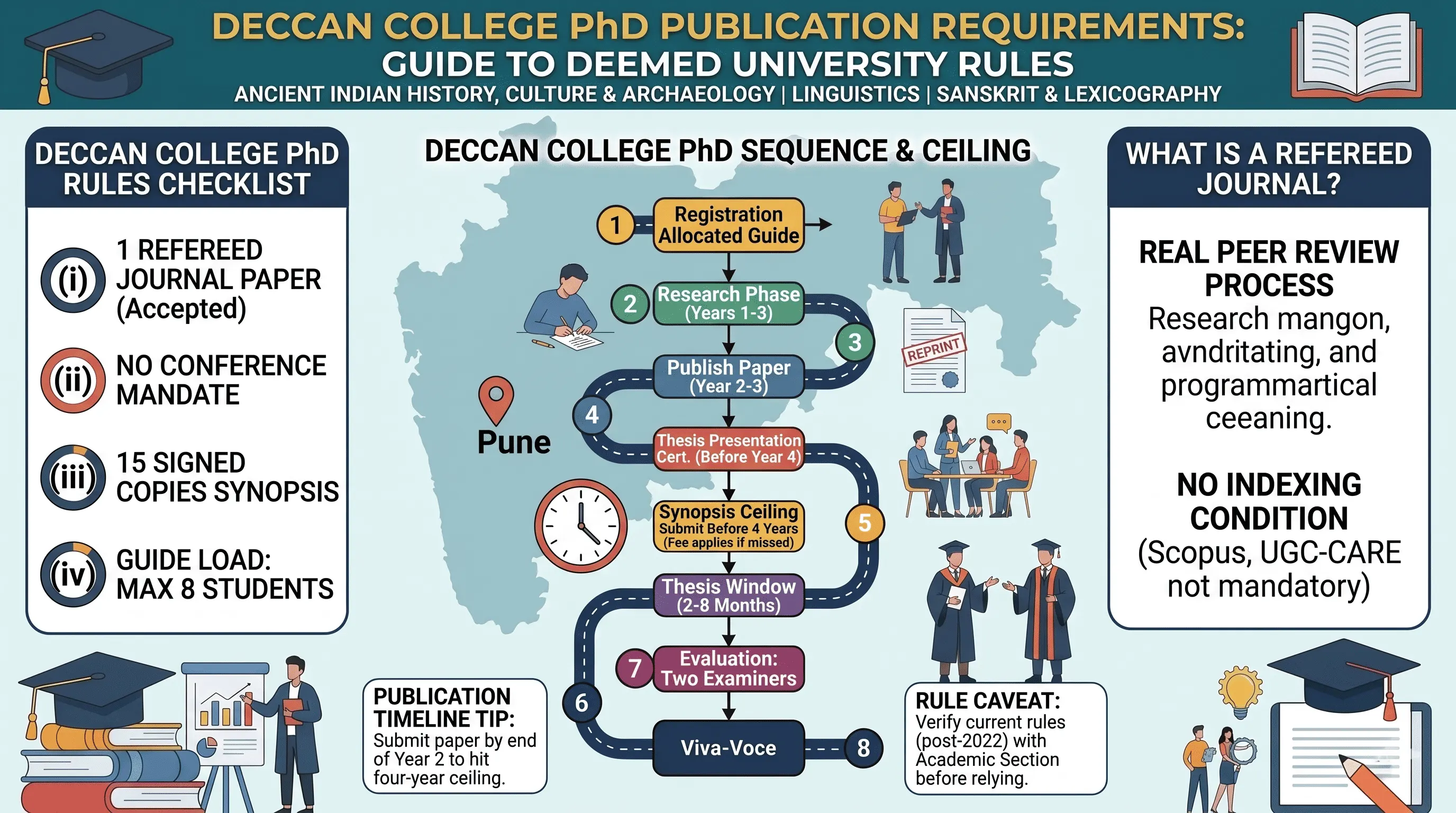
Deccan College Post-Graduate and Research Institute is a public deemed university in Pune, founded in 1821 and the third oldest educational institution in India. It awards doctorates in three fields only — Ancient Indian History, Culture and Archaeology, Linguistics, and Sanskrit and Lexicography — and is the only institution in the country dedicated exclusively to these subjects at postgraduate level. Its Ph.D. rules require one research paper in a refereed journal before the thesis goes for adjudication, with no indexing condition and no conference requirement. The clause that catches scholars out is not the publication rule at all — it is the four-year ceiling on the synopsis. This page sets out both.
📍 Part of our Maharashtra university requirements guide. See also: Paper Publication in Maharashtra · GIPE · SPPU · UGC-CARE
Deccan College PhD Publication Requirement — What the Rules Say
| Papers required | One research paper in a refereed journal, before submission of the thesis or monograph for adjudication |
| Indexing condition | None — no Scopus, Web of Science, UGC-CARE or quartile requirement |
| Conference presentations | Not required |
| Evidence required | Acceptance letter or reprint, produced before thesis submission |
| Synopsis deadline | Before completion of four years from the date of registration |
| Synopsis paperwork | 15 signed copies plus soft copy, thesis presentation certificate from the Head of Department, prescribed fee |
| Thesis window | After 2 months and within 8 months of final synopsis; +4 months on Departmental Committee approval |
| If the window lapses | Synopsis fee paid again, then a further 8 months, within the total registration period |
| Registration period | Five or six years |
| Thesis copies | Four hard copies (five where there is a co-guide) plus two soft copies of thesis and final synopsis |
| Thesis format | Spiral bound, typescript or print, double spacing, paper 225 × 290 mm |
| Examiners | Two external; reports due within three months; third examiner where they disagree |
| Supervisor load | A research guide may hold no more than eight Ph.D. students at any time |
| Disciplines | AIHC & Archaeology, Linguistics, Sanskrit & Lexicography |
Sourced from the Institute's published Ph.D. rules pages. Last verified 17 August 2026. Presentation of the Thesis · Ph.D. Degree Examination. See the note below on the age of these rules, and confirm with the Academic Section before relying on them.
An Important Caveat About These Rules
The Ph.D. rules published on the Institute's website carry a 2020 copyright, reference the Institute's Revised Rules of 2000, and include a seat-availability page for 2022-23. They do not appear to have been revised since the UGC (Minimum Standards and Procedure for Award of Ph.D. Degree) Regulations, 2022 came into force in November 2022.
That does not make them wrong — institutions are free to keep a publication requirement after the UGC dropped the national mandate, and many have. But it does mean the pages online may not be the current version. Before you plan around anything here, ask the Academic Section whether a post-2022 revision exists, and ask for it in writing. Given the four-year synopsis ceiling described below, a rule change you did not know about is expensive.
The Four-Year Synopsis Ceiling
This is where Deccan College differs from every other institution in this guide. Most set a floor: you may not submit before three years. Deccan College sets a floor and a ceiling — the final synopsis must be submitted before the completion of four years from your date of registration.
Work through what that means for publication. Your paper must be accepted, with the acceptance letter in hand, before that four-year mark. Humanities journals in archaeology, linguistics and Sanskrit studies frequently run review cycles of six to twelve months, and many publish once or twice a year. A submission made in year three that comes back with major revisions can very easily miss the ceiling.
The practical rule: submit your paper by the end of year two. That leaves room for one full rejection-and-resubmission cycle inside the window. Scholars who treat publication as a year-four task are the ones who end up re-paying the synopsis fee.
| Stage | Deccan College | Typical elsewhere in Maharashtra |
|---|---|---|
| Minimum before submission | Registration period applies | 3 years |
| Maximum to synopsis | 4 years from registration | Usually uncapped within the registration period |
| Synopsis to thesis | 2–8 months, +4 on approval | Commonly 2–6 months |
| Total registration | 5 or 6 years | Commonly 6, extendable to 8 |
Where to Publish in Archaeology, Linguistics and Sanskrit
The rule asks for a refereed journal and nothing more, which is genuinely helpful in these fields — many of the most respected outlets in Indology, historical linguistics and archaeology are society journals or institutional annuals that never appear in commercial indexes. A journal does not need to be Scopus-listed to satisfy Deccan College.
What it does need is a real peer review process you can evidence. Routes and timelines:
| Route | Realistic timeline | Indicative cost (INR) | Best for |
|---|---|---|---|
| Subject society or institutional journals | 6–12 months | Usually nil | Disciplinary standing; start these earliest |
| UGC-CARE | 3–6 weeks | From 3,000 | Refereed publication on a short timeline |
| Scopus | 4–12 weeks | From 15,000 | Academic job market, post-doctoral applications |
| Springer | 2–5 months | From 18,000 | Archaeological science and interdisciplinary work |
| Fast track | 7 days – 4 weeks | From 5,000 | Four-year mark approaching |
Full breakdown on our paper publication cost page. Because an acceptance letter satisfies the rule, review turnaround matters far more here than the publication schedule.
The Deccan College Submission Sequence
- Admission — through the Institute's entrance test, with exemption for UGC-NET, UGC-JRF, CSIR, SET and M.Phil. holders, followed by interview and presentation before the Departmental Committee.
- Registration — a research guide is allocated by the Department, not chosen by the student. A guide holds no more than eight research students at a time.
- Research — the title and guide may be changed only once, with Departmental Committee approval, and only before the final synopsis.
- Publication — one refereed journal paper, accepted, with the letter or reprint retained.
- Thesis presentation — obtain the Ph.D. thesis presentation certificate from your Head of Department.
- Final synopsis — before four years from registration. Fifteen signed copies plus a soft copy and the prescribed fee, forwarded through your guide and Head of Department.
- Thesis — after two months and within eight of the synopsis. Four hard copies, or five where you have a co-guide, plus two soft copies. Spiral bound, double spaced, 225 × 290 mm.
- Evaluation — two external examiners, reports within three months. Accept, resubmit after revision, or reject; a third examiner resolves a split.
- Viva-voce and open defence — you circulate synopsis copies to those attending.
- Award — the Academic Section places the examiners' reports before the Academic Council, which confirms or rejects the award.
Deccan College Thesis Submission Checklist
- One refereed journal paper — acceptance letter or reprint retained
- Ph.D. thesis presentation certificate from the Head of Department
- Final synopsis submitted before four years from registration
- Fifteen copies of the synopsis, signed by you, your guide and co-guide
- Soft copy of the synopsis to the Academic Section
- Prescribed synopsis fee paid
- Thesis submitted between two and eight months after the synopsis
- Four hard copies (five with a co-guide) plus two soft copies
- Spiral bound, typescript or print, double spacing, 225 × 290 mm paper
- Registration period of five or six years not exceeded
Plan Backwards From the Four-Year Mark
- Year 2, first half — identify your target journal with your research guide. In these disciplines the strongest outlets are often annuals, so check the submission calendar before anything else.
- Year 2, second half — first submission. Assume six to twelve months to a decision.
- Year 3, first half — revisions, or reroute to the next journal without waiting for a stalled review.
- Year 3, second half — acceptance letter in hand. This is the buffer you will be glad of.
- Before year 4 — thesis presentation certificate, then the final synopsis with its fifteen copies.
- Synopsis + 2 to 8 months — thesis submitted.
Frequently Asked Questions — Deccan College PhD Publication
How many papers are required for a PhD at Deccan College?
One. The Institute's Ph.D. rules require a student to publish one research paper in a refereed journal before submitting the thesis or monograph for adjudication, and to produce evidence in the form of an acceptance letter or the reprint before submission. There is no requirement for conference presentations.
Does Deccan College require a Scopus or UGC-CARE journal?
The rules say 'refereed journal' and set no indexing condition — no Scopus, no Web of Science, no UGC-CARE clause and no quartile restriction. For Archaeology, Linguistics and Sanskrit scholars this matters, because many of the strongest journals in these fields are society or institutional publications that sit outside the commercial indexes. What the rule does require is genuine peer review, so your Departmental Committee will be looking at the journal's review process rather than an index listing.
Does an acceptance letter count at Deccan College?
Yes. The rules accept an acceptance letter or the reprint as evidence, so you do not have to wait for the issue to appear in print. Get the letter on the journal's letterhead or from the editor's official address, since that is what you will enclose with your submission paperwork.
When must I submit my synopsis at Deccan College?
Before the completion of four years from your date of registration. This is a ceiling, not a floor, and it is the single most important date on this page. Most universities set a minimum of three years before you may submit; Deccan College also caps when the synopsis must be in. Your publication has to be accepted before that four-year mark, not merely in progress.
How long do I have between synopsis and thesis?
The thesis is submitted after two months and within eight months of the date the final synopsis was submitted. If the Departmental Committee approves, an additional four months may be granted. Beyond that you pay the synopsis fee again and get a further eight-month window — provided the total does not exceed the Ph.D. registration period of five or six years. The eight-month window is more generous than most Maharashtra institutions, which typically allow six.
What do I submit with the final synopsis?
An application forwarded through your research guide and the Head of Department, the Ph.D. thesis presentation certificate obtained from the Head of Department, fifteen copies of the final synopsis signed by you, your research guide and co-research guide, a soft copy for the Academic Section, and the prescribed fee. The fifteen copies are for distribution among committee members finalising the panel of examiners.
How is the Deccan College thesis evaluated?
Two external examiners receive hard copies and must submit their reports within three months, failing which the thesis is recalled and sent to the next examiner on the panel. Each concludes that the thesis be accepted, resubmitted after revision, or rejected. If both reject, you are declared to have failed, though you may register afresh with Departmental Committee approval. If the two disagree, a third examiner on the panel evaluates it. The award is then confirmed by the Academic Council after the viva-voce and open defence.
What subjects can I do a PhD in at Deccan College?
Three: Ancient Indian History, Culture and Archaeology; Linguistics; and Sanskrit and Lexicography. Deccan College is the only institution in India dedicated exclusively to research and teaching in these fields at postgraduate level. Admission is through the Institute's entrance test, with exemption for holders of UGC-NET, UGC-JRF, CSIR, SET or an M.Phil.
Not Sure Your Paper Is Ready?
Send your draft for a free readiness check. You will get an honest assessment of whether the manuscript is ready for the journals that matter in your field, and a realistic review timeline measured against your four-year synopsis deadline. If a subject society journal is the better home for your work than anything we publish, we will tell you that.
📄 Free Manuscript Evaluation — Deccan College Scholars